

Of all the bizarre creatures who share their world with us, perhaps none are as strange as mycelia, commonly known as molds. Unlike us, whose bodies envelop organs like our stomach, molds are covered with cells that excrete enzymes and literally digest their surroundings. Look at a piece of rotten wood, and you’ll know that mycelia have eaten there.
Mold is receiving increased emphasis as a health care concern. Most molds are harmless (and invisible) to humans, and some famous ones—like penicillium—are even beneficial.
But large colonies of mold become visible and, in some
cases, highly toxic. For example, the black mold Stachybotrys chartarum
has
been
associated with
pulmonary
hemorrhage and “sick building syndrome.” Excessive exposure to
mold may cause allergic reactions or aggravate a variety of respiratory problems
like
asthma, coughing, chest congestion, or shortness of breath.
While there is no practical way to prevent mold, keeping things dry and clean
can help control it.
The EPA offers practical mold remediation information for professionals and homeowners alike. Go to http://www.epa.gov/iaq/molds/.
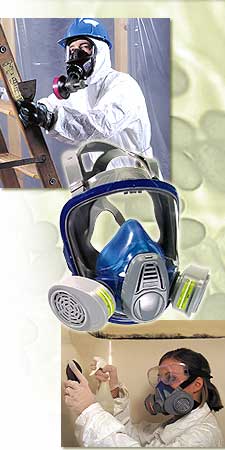
Respiratory protection during mold remediation
During mold remediation, respiratory protection is highly recommended to reduce inhalation of molds, their spores, and other dusts. The products and processes used are similar to those used in asbestos abatement. In fact, many abatement businesses are now chasing and cleaning up mold in houses and commercial buildings.
MSA’s Advantage® 3000 and 200 LS Respirators with P100 filters can provide protection against airborne mold particles and spores. Use a GMC P100 cartridge if using hypochlorate as a disinfectant.
The OptimAir® MM 2K PAPR works well for mold remediation and abatement, filtering particulates from ambient air and providing a constant flow of respirable air. The mask-mounted motor/blower with HEPA filter has a low-profile design that enhances user maneuverability and simplifies decontamination. For protection against chemical cleaning solvents, choose the OptimAir® 6A PAPR.
If you’re in mold remediation, call 1-800-MSA-2222,
and ask for MSA’s “Personal Protection during
Mold Remediation” Bulletin 5555-169.