

Pastor Jim Stevenson got the call early on the morning of January 19, 2003: The air in his Honey Creek Missionary Baptist Church in Russiaville, Indiana, was heavy with the acrid smell of gasoline.
“It burned my eyes,” recalled Stevenson’s
wife Sharon. “It was very, very strong.”
The Russiaville (Roosh-a-ville) Volunteer Fire Department quickly arrived
at the church, and assessed the interior with an Orion® Multigas
Detector. It smelled bad, but there was neither danger of explosion nor
immediate danger to life or health. Still, there would be no church services
that day.
Because of two bulk gasoline facilities in Russiaville, the smell of gasoline is occasionally noticeable in the air. But these fumes were heaviest indoors—in kitchens and bathrooms. Somehow gasoline had gotten into Russiaville’s sanitary sewer system. The Orion detector had more work to do.
Good thing they had planned ahead...
Russiaville is small, less than a square mile, with a population of under 1000. The Russiaville Fire Department wisely decided to apply for a FEMA Assistance to Firefighters Grant to help them buy some new equipment. Rob Dornseif of 5 Alarm Fire and Safety Equipment, Inc. (their MSA distributor in Fort Atkinson, Wisconsin) was instrumental in helping Russiaville choose MSA. “MSA’s Orion detector is a great instrument for small departments. Its durability and extendable warranty make it an attractive and economical choice.”
“With hazardous materials situations being a lot more prevalent nowadays,” Assistant Chief Brad Myers agreed, “we need early warning signs for both firefighters and public safety.” Several of Russiaville’s volunteer firefighters use MSA products in their paid positions, so they were already sold on MSA.
Dornseif’s research and experience with the FEMA Grant process taught him what successful applications looked like. He provided samples of winning narratives to Russiaville VFD. They applied for and received a grant to buy some large-diameter hose and one Orion Multigas Detector from MSA.
Orion might have saved the town...
Less than three months after they got the instrument, about 6000 gallons of gasoline leaked from a nearby bulk facility. Once in the sanitary sewer system, it could have put the whole town in danger, for any spark could cause a massive underground explosion and fire.
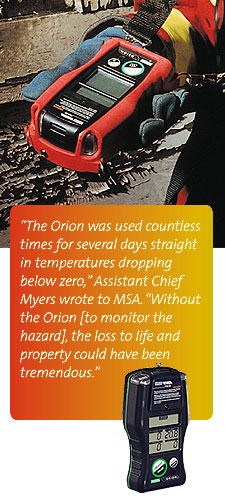
With outside temperatures close to 0º F., a mass evacuation could have been more than just a minor inconvenience. And, if fumes were concentrated enough to reach their Lower Explosive Limit, homes and business would have to shut down entirely. The single Orion unit enabled the firefighters to monitor buildings for three or four days.
“[Again and again,] the Orion gave us the precise readings we needed to decide whether we had to evacuate certain areas of town,” Myers said. “Without it, we would have had nothing but our noses.”
Click here for online product information about the Orion Detector.